SECENG WORKBENCH
The AI security workbench behind our assessments, red teams, hardening, and evidence
One technical workflow for mapping systems, testing attack paths, verifying controls, and exporting evidence teams can use.
Workbench-backed delivery
SecEng Workbench is the engine behind assessments, red-team work, hardening, buyer evidence, and selected tooling licenses.
Instruments map systems, seed attack paths, validate controls, and package evidence. SecEng Code Scanner is also available as a separate tooling license for repeatable AI-native SAST, developer exports, and marketplace-readiness evidence.
Platform and services
Platform and services are related—but not the same product
AI Security LLC's expert-led engagements are powered by the SecEng Workbench. The platform provides reusable technical infrastructure; security practitioners scope the work, interpret the system, test the hard paths, validate impact, and guide remediation.
Selected Workbench components are also available through separate software licensing and OEM arrangements.
Move from system context to a defensible security decision.
The Workbench carries architecture, trust boundaries, code, configuration, runtime behavior, identities, tools, findings, controls, and retest state through one connected delivery flow.
Workbench Capability Flow
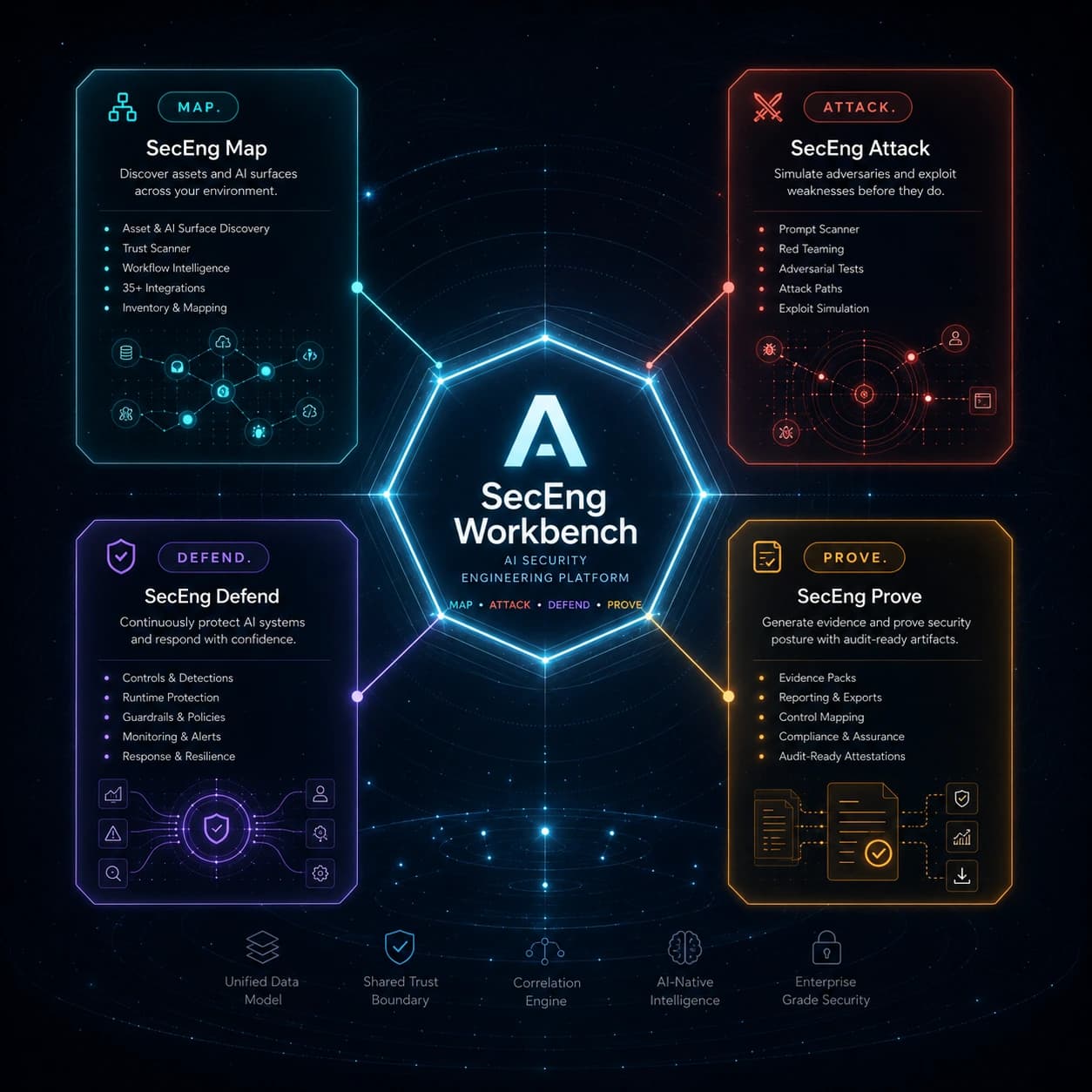
Map, scan, test, chain, defend, and prove operate as connected capabilities rather than isolated tools.
Ecosystem map with the SecEng Workbench at the center and Map, Scanner, Authority Graph, Adversarial Range, APC, Defend, and Evidence capabilities around it.
- Shared evidence and lifecycle state
- Shared contracts and identifiers
- Reusable outputs and regression proof
Individual tools remain useful on their own, but the strongest result comes from preserving context as the work moves from discovery into testing, remediation, and evidence.
Map
Build the system, data-flow, trust-boundary, tool, and identity model.
Attack
Test realistic paths across prompts, retrieval, tools, agents, code, and runtime behavior.
Defend
Turn findings into controls, permission changes, remediation work, and retests.
Evidence
Export findings, attack paths, remediation status, control proof, and structured artifacts.
One lifecycle. Four pillars. A growing instrument set.
Map the system. Attack the weak points. Defend the release path. Package control evidence.
Each instrument works alone, but together they support the full path from red-team finding to blue-team fix to governance evidence.
SecEng Map
Find every AI surface, agent, workflow, tool, retrieval path, and data exposure.
SecEng Attack
Run adversarial tests against prompts, agents, tools, retrieval, policies, and model behavior.
SecEng Defend
Turn findings into controls, guardrails, detections, approval gates, and release criteria.
SecEng Evidence
Generate evidence packs, control mappings, framework crosswalks, and audit-ready exports.
Featured Attack Instrument
SecEng Code Scanner
AI Attack-Path SAST for MCP, RAG, browser-agent, AI coding agent, and tool-calling code. Groups static signals into attack paths, validation plans, CVE candidates, developer exports, and marketplace-readiness evidence.
Keep evidence intact as it moves between products.
A finding should preserve stable identity, source evidence, affected assets, claim state, confidence, remediation, version history, retest state, and analyst decisions as different SecEng capabilities consume or extend it.
Cross-Product Evidence Contract
Shared evidence and lifecycle states allow scanner, range, graph, APC, and reporting capabilities to exchange results without losing provenance.
Round-trip integration figure showing scanner, adversarial range, authority graph, APC, remediation, retest, and reporting sharing one evidence contract.
- 1Capability outputScanner finding • Adversarial observation • Artifact context
- 2Shared evidence contractStable identifiers • Source and provenance • Claim and lifecycle state • Entities and relationships
- 3Downstream analysisAuthority Graph enrichment • APC qualification • Control and retest planning
- 4Lifecycle returnRemediation state • Retest result • Reporting and export
The shared evidence contract allows products, services, partner integrations, and customer-facing outputs to exchange useful state without exposing unnecessary internal implementation or flattening every result into one generic finding.
Workbench modules may have different readiness, deployment, and licensing states — internal delivery capability, demonstrable product surface, pilot-ready capability, licensed or supported product, fixture-tested integration, live validated integration, or planned capability. The applicable product page, pilot scope, and executed agreement define what is supported for a particular use.
Structured interfaces, evidence contracts, supported deployment modes, and customer-safe outputs can be reviewed without exposing internal prompts, detector definitions, rule catalogs, scoring logic, validation internals, proprietary corpora, or unrelated customer evidence.
Deployed in consulting engagements
Services that use these instruments.
Workbench instruments are deployed during structured consulting engagements. SecEng Code Scanner is also available as a separate tooling license when teams need repeatable AI-native SAST, SARIF/VS Code/Jira exports, and marketplace-readiness evidence.
Live demos — fixture-driven
See each instrument in action.
Every instrument ships with a fixture-driven live demo. Walk through a real run — no setup required.
Where are the trust boundaries?
SecEng Threat Canvas
DFD-style AI threat modeling with Jira export and Confluence evidence.

Service modes
Red-team depth. Blue-team hardening. Governance evidence.
The Workbench keeps the service buckets connected. Red-team work produces reproducible findings. Blue-team work turns them into controls and telemetry. Governance work packages the evidence.
Red Team · Map + Attack
We find real attack paths.
- Map AI surfaces before adversaries fingerprint them
- Reproduce prompt injection, jailbreak, RAG, and agent abuse paths as product-security findings
- Build agent abuse chains from real tool compositions
- Poison RAG corpus and validate detection coverage
- Generate regression tests from every confirmed exploit
Blue Team · Defend
We turn findings into controls.
- Design permission boundaries, approval gates, and rollback paths
- Build logging, telemetry, and detection requirements for prompts, retrieval, and tool calls
- Convert exploits into evals, regression tests, and release gates
- Define control owners and operational runbooks
- Track remediation from finding to shipped fix
Governance · Evidence
We package evidence buyers and auditors can use.
- Generate evidence bundles for product security, AppSec, GRC, legal, and procurement
- Map findings to OWASP LLM, NIST AI RMF, MITRE ATLAS, ISO 42001, SOC 2, and EU AI Act language
- Create control ownership maps and evidence lifecycle notes
- Produce buyer-ready trust language and questionnaire support
- Deliver board, legal, and governance exports
Standards alignment
Every finding maps to a control framework.
Framework
OWASP LLM Top 10
Application-level LLM risks: prompt injection, insecure output handling, data disclosure, and supply chain.
Framework
NIST AI RMF / GenAI Profile
Risk management language for AI governance: govern, map, measure, manage. GenAI profile adds model-specific controls.
Framework
MITRE ATLAS
Adversarial tactics, techniques, and procedures for AI systems. Maps red-team findings to known adversary behavior.
Framework
ISO 42001
AI management system standard. Evidence packages from every instrument map to ISO 42001 controls for audit readiness.
Three ways to use the Workbench
Choose how you access the platform
Expert-led engagement
We use the Workbench during assessments, red teams, hardening, and evidence work.
Review servicesSoftware access
Selected capabilities can be licensed for internal security and engineering workflows.
Ask about licensingOEM integration
Partners can embed selected engines and outputs into their own products and delivery workflows.
Explore OEM integrationSECENG WORKBENCH
Start with the capability that answers the immediate problem.
Use the Workbench as a connected delivery substrate, but begin with one bounded scanner, authority, adversarial, evidence, assessment, or partner workflow that can be evaluated against a real outcome.