
SECENG WORKBENCH
AI Red-Team Scenario Harness
Run adversarial tests. Find real failures. Stop breaches.
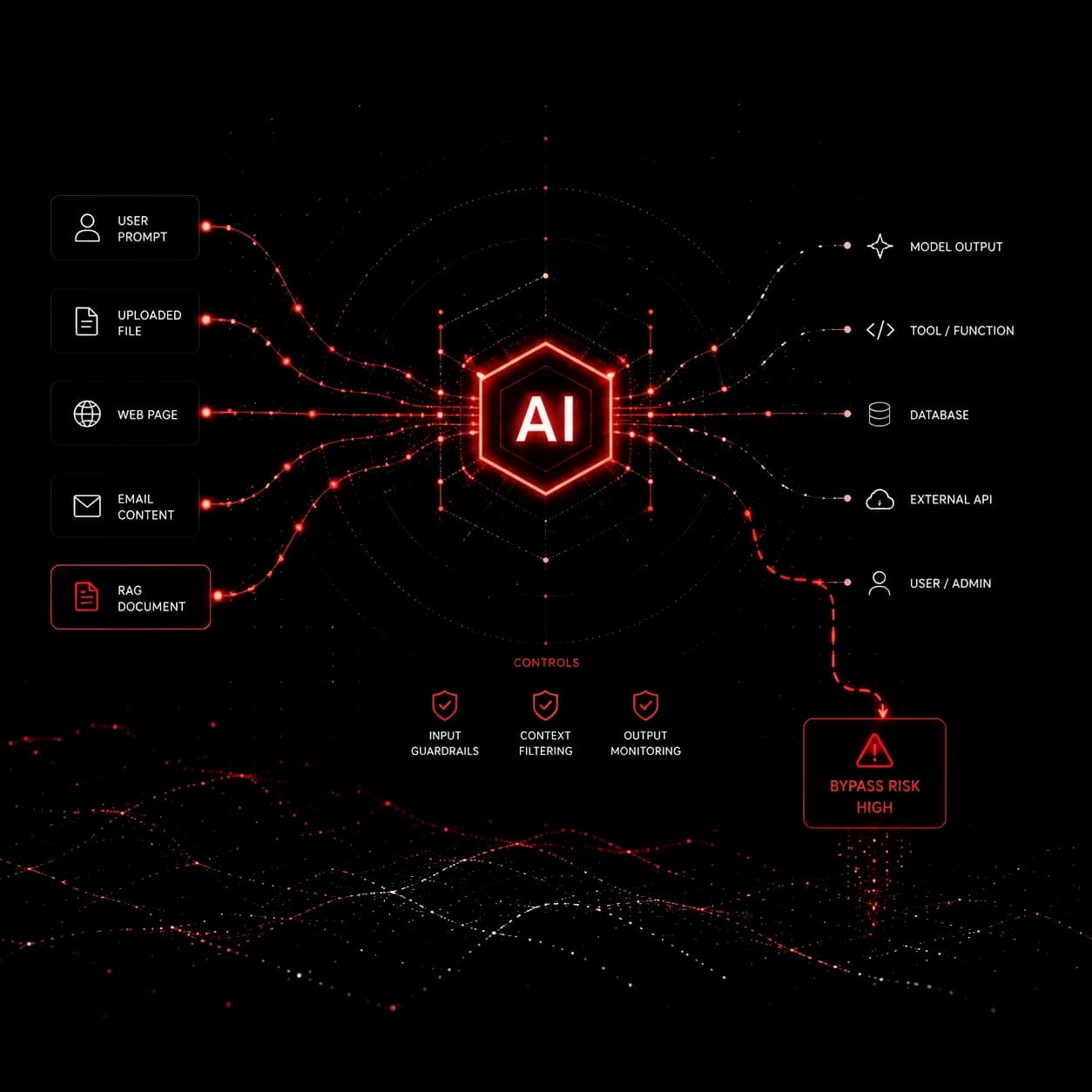
Scenario-driven AI red-team testing for prompts, agents, tools, RAG pipelines, and multimodal systems. Test against the attacks that matter — prompt injection, jailbreaks, tool abuse, data leakage, RAG poisoning, and policy bypass. Map results to control coverage and replayable evidence.
Attack-Pack Breadth
Fifteen active namespaces cover 157 scenarios and 22 threat vectors across prompt injection, agentic abuse, multimodal, and supply chain.
Control Mapping
Every failure maps to OWASP LLM, NIST AI RMF, MITRE ATLAS, ISO 42001, and EU AI Act control language.
Evidence-Driven
Each scenario produces an evidence pack, control rollup, and registry snapshot instead of just a pass/fail result.
Replay-Ready
Use all eight first-class adapters — promptfoo, garak, PyRIT, AgentDojo, Giskard, Inspect AI, NeMo Guardrails, and OpenAI Evals — to rerun failures as durable regression tests.
157
Scenario files in the current registry
15
Active attack packs
8
Tool adapters
22
Threat vectors represented
Core capabilities
What SecEng Adversarial Range does.
Direct & Indirect Prompt Injection
Test direct prompt injection through user inputs and indirect injection from web pages, RAG documents, tickets, emails, and uploaded files. Reproduce the full injection surface with evidence and replayable traces.
Agentic Tool Abuse
Simulate delegated authority abuse, unsafe tool chains, approval bypass framing, and unauthorized external actions across agent workflows.
Multimodal & Synthetic Media
Exercise OCR, EXIF, steganography, image prompts, and synthetic-media abuse paths so output safety controls are tested where users actually see the model.
Model & Data Integrity
Probe backdoors, inversion, membership, drift, and training-data poisoning so the harness can distinguish leakage from model-integrity failure.
Coverage & Gap Reporting
Track explicit versus inferred coverage, uncovered control gaps, weak-evidence controls, and ATLAS/NIST rollups in one public-safe snapshot.
Replay & Forensics
Export replay-friendly traces, SARIF, ECS JSON, and control mappings so red-team discoveries can become durable regression fixtures.
Evidence & signals
What you get out of the box.
Attack Categories
- Prompt Injection
- Data Exfiltration
- Tool Abuse
- RAG Poisoning
- Multimodal Abuse
- Supply Chain Poisoning
- Model Integrity
- DoS
Scenario Results
- Explicit coverage: 157 / 157 scenarios
- Uncovered controls: 0
- Uncovered ATLAS techniques: 0
- High-confidence findings: 5
Export Evidence
- Evidence Pack (ZIP)
- Results Report (PDF)
- Control Mapping (CSV)
- SARIF / ECS JSON
Red team + Blue team
Built for both sides of the security equation.
Red Team Use
- Reproduce real exploit paths across prompt injection, agent authority, multimodal abuse, and data leakage.
- Run all eight first-class adapters — promptfoo, garak, PyRIT, AgentDojo, Giskard, Inspect AI, NeMo Guardrails, and OpenAI Evals — against the same scenario registry.
- Generate regression fixtures from every successful attack and preserve the evidence trail for reruns.
Blue Team Use
- Convert failures into prioritized remediation with control mapping, owner assignment, and public-safe rollups.
- Validate explicit versus inferred coverage before every AI feature release and close gaps early.
- Build eval-to-release gates with OWASP LLM, NIST AI RMF, MITRE ATLAS, ISO 42001, and EU AI Act alignment.
AI SECURITY ENGINEERING WORKBENCH
Ready to put SecEng Adversarial Range to work?
Scope a Workbench-backed review — we'll map the AI surfaces, identify the highest-priority gaps, and give you clear findings before any larger commitment.
Also in the Workbench
WHAT AI DO WE HAVE?
SecEng Surface Scanner
Browser, Repo & IDE AI Discovery
WHAT DID IT ACTUALLY DO?
SecEng Runtime Proxy
MITM Capture, Replay & Runtime Evidence
WHAT CAN AGENTS ACTUALLY DO?
SecEng Authority Graph
Agent Authority & Approval-Path Analysis
WAS RETRIEVAL AUTHORIZED?
SecEng RAG Test Harness
Retrieval & Context Security Test Harness
SecEng Attack · instrument
Show the Adversarial Range dashboard with a fixture-driven ACME Corp red team run.
Open the live demo route to walk through the same attack scenario browser, findings table, framework coverage maps, and residual risk register using a stable public-safe sample payload.
Scenario corpus
Fixture-led
Demo data stays public-safe and replayable.
Coverage model
Framework mapped
Controls, findings, and gaps stay in one taxonomy.
Release posture
Build-ready
Styled to match the rest of the SecEng Workbench.